Free Party Movement – Sound Systems and the CJA
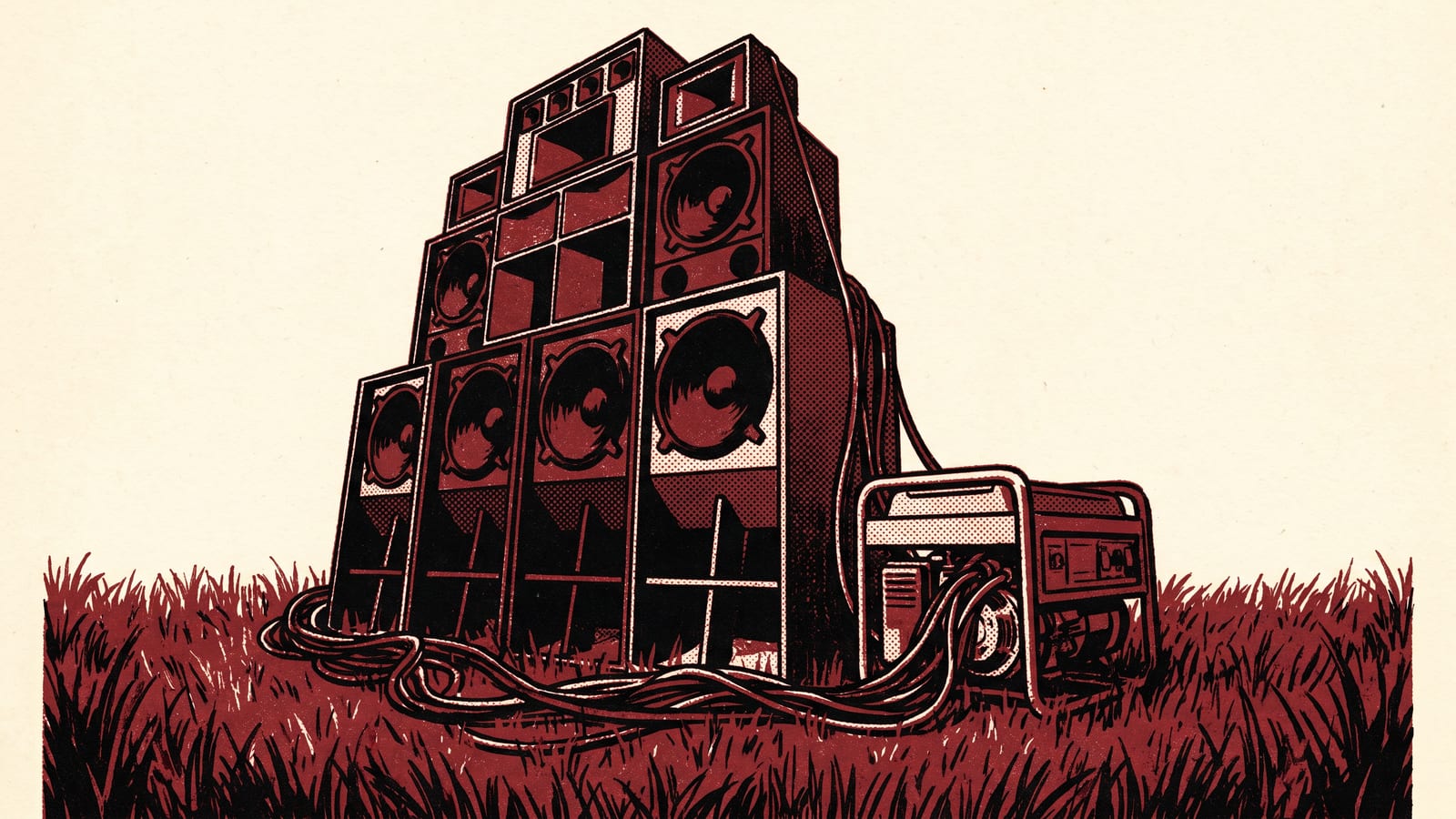
The free party movement did not emerge from nowhere. It grew directly out of the Second Summer of Love in 1988, when acid house spilled out of clubs like Shoom and Spectrum and into fields and warehouses across Britain. Once people had experienced dancing outside, in the dark, with a proper system, the licensed club felt small and managed by comparison.
Sound Systems and the Traveller Circuit
The infrastructure came from two directions at once. One was the existing calendar of outdoor free events, running through the 1980s on the traveller and festival circuit, attended mainly by new age travellers, anarcho-punks, squatters and crusties. The other was the house music explosion. When those two worlds collided, the travelling sound system was the result.
Crews like DiY, who emerged from Nottingham, became a vital link between the two worlds. Spiral Tribe came later but burned brighter: a London-based collective who built their own rigs, painted their gear black, and took a confrontational line with authority from the start. By the early 1990s a growing number of sound systems, including Bedlam, Circus Warp and LSDiesel, were moving around the country in convoys of converted vehicles, setting up on common land and playing until the police arrived. This is the part of rave culture that the commercial side could not absorb.
Castlemorton Common, May 1992
What happened in the last week of May 1992 was not planned as a statement. The Avon Free Festival, which had been displaced from its usual site, effectively merged with several sound system convoys that were already moving through the west of England. They ended up on Castlemorton Common in the Malvern Hills, Worcestershire, on 22 May.
Seven sound systems were already set up that Friday morning. By the end of the day the crowd was tens of thousands strong, with estimates ranging between 20,000 and 50,000 over the course of the week. The sound systems present included Spiral Tribe, Bedlam, Circus Warp, DiY, and others. It ran until 29 May, full week, uninterrupted, while Malvern Hills District Council sought an injunction and the police stood around not quite knowing what to do. There was no legal mechanism to move anyone quickly.
The television coverage was enormous. For the tabloids it was a simple story: crusties, drugs, chaos. For the people there it was something else, one of those events that feels, while it is happening, like proof that a different arrangement of things is possible.
Spiral Tribe and the Prosecution
The aftermath was brutal for Spiral Tribe specifically. Thirteen members were arrested and charged with conspiracy to cause a public nuisance. The trial at Worcester Crown Court ran for ten weeks and cost the state an estimated £4 million, one of the most expensive prosecutions in British legal history at the time. The jury acquitted all thirteen in March 1994.
By that point Spiral Tribe had already left the country. The pressure had made staying untenable. They moved through the Netherlands, Germany and France, and in the summer of 1993 put on what became the first Teknival in Beauvais, France, coining the name for a new format of European free parties that continues to this day.
Section 63 and the Repetitive Beats Clause
Parliament was already moving before the trial concluded. The Criminal Justice and Public Order Act 1994 passed into law on 3 November 1994. Section 63 gave police the power to shut down any open-air gathering of 100 or more people at which amplified music was played during the night, where that music was “wholly or predominantly characterised by the emission of a succession of repetitive beats.”
That phrase was not accidental. It was a statutory definition of techno and house music, written to be unambiguous about what the law was targeting. The same section allowed police to act when as few as ten people were attending, or when just two were making preparations. Section 65 went further, allowing any uniformed constable who believed a person was heading to a rave within a five-mile radius to stop and redirect them.
The effect was to push dance music towards nightclubs and licensed events. The sound systems did not disappear, but operating in Britain became significantly harder. Protests against the bill drew large crowds before it passed, and the Labour opposition abstained at third reading, which did not go down well with the people directly affected.
What the Movement Left Behind
Free parties never ended. They adapted, moved underground, moved to Europe, or continued on smaller scales. The teknival format that Spiral Tribe helped seed in France generated its own scene, with gatherings now running across continental Europe each summer.
The CJA also had a longer political legacy. The same act targeted squatters, travellers and protesters, which meant the coalition opposing it was unusually broad. For many in the free party scene, the fight against the bill was the moment it became explicitly political, not just countercultural.
The argument the movement made, that music and gathering on common land ought to be free, was not a complicated one. The state’s response to it, tens of millions in policing and prosecution costs plus a new law defining music by its beat structure, suggests it was taken seriously.