Glam Rock – Glitter, Androgyny, and Excess
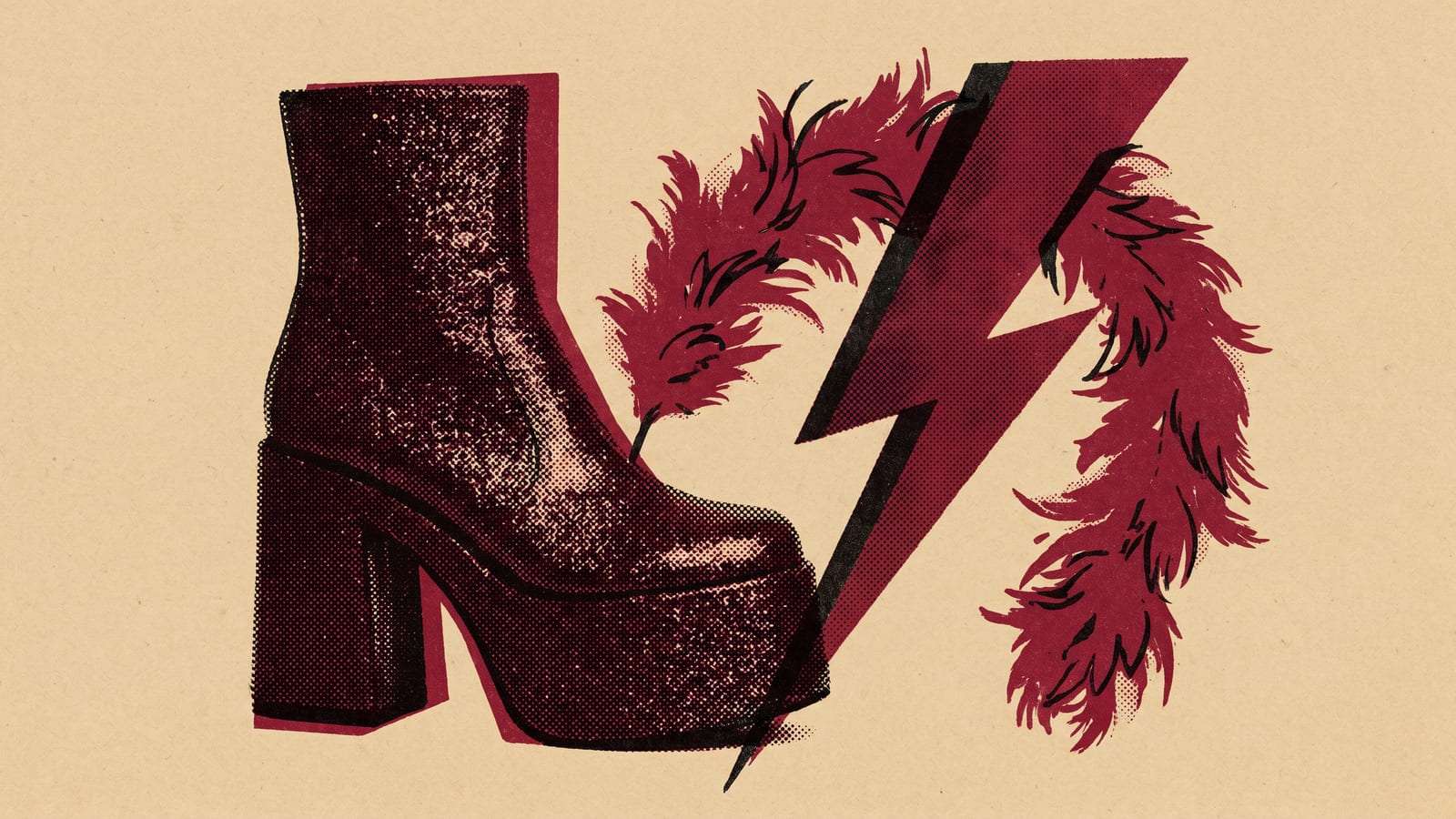
Glam rock was a deliberate provocation. It arrived in Britain around 1971 wearing platform boots, face paint, and sequined jumpsuits, and it made no apology for any of it. The music was loud and hookish; the image was the point. For a few years in the early 1970s it dominated the charts and the front pages, and then it collapsed as suddenly as it had appeared, leaving a residue that ran through punk, and then straight into the New Romantics.
Marc Bolan and the spark
T. Rex is where most accounts start, and fairly. Marc Bolan had been a mod, then a hippie acoustic folkie, then something else entirely. By 1971, when “Electric Warrior” arrived, he had stripped his music back to a Bo Diddley stomp and put on glitter eyeshadow. The combination was unexpectedly explosive. “Get It On” reached number one in the UK that year, and Bolan was suddenly the first genuine British teen idol of the decade. The look, cheekbones smudged with star-shaped glitter, feather boas, satin flares, was as much the product as the records.
What Bolan understood was that the artifice was the honesty. He was performing a fantasy of rock stardom and making no bones about it. That attitude permission-slipped everything that followed.
Bowie and the alter ego
David Bowie arrived at glam from a different angle. He was always more interested in character and concept than in straightforward rock and roll, and glam gave him the framework he needed. The Ziggy Stardust persona, introduced on “The Rise and Fall of Ziggy Stardust and the Spiders from Mars” in 1972, was a fully constructed fictional rock star, alien, doomed, bisexual, wearing costumes by Kansai Yamamoto that drew on Japanese theatre and science fiction in equal measure.
The androgyny was explicit and thought-through. Bowie posed in a dress on the cover of “The Man Who Sold the World” in 1971 and told interviewers he was gay (later revised to bisexual, later revised again). The point was not necessarily biographical accuracy but the destabilisation of the obvious. Glam rock’s mainstream success made gender ambiguity pop, something that had never really happened before in British music.
The charts end of the spectrum
Alongside Bolan and Bowie there was a less art-school version of glam that was arguably more influential commercially. Slade, from the Black Country, brought a working-class stomp to the format: stomping piano, misspelled song titles (“Cum On Feel the Noize,” “Mama Weer All Crazee Now”), and Noddy Holder in a mirrored top hat. The Sweet mixed bubblegum pop production with heavier guitars and a harder stage image. Gary Glitter went furthest into pure spectacle, the platform soles reaching comedic heights.
Roxy Music occupied a more cerebral corner. Bryan Ferry’s lounge-lizard persona and Brian Eno’s electronics gave their early records a queasy sophistication that sat oddly alongside the glitter stomp of the charts, but they were recognisably part of the same moment: the conviction that presentation and artifice were not cheating, they were the art.
Why it ended
Glam’s mainstream run was short. By 1974 and 1975 the first wave was already fragmenting. Bowie moved on to “Diamond Dogs” and then the Philadelphia soul of “Young Americans.” Marc Bolan struggled to maintain the commercial momentum, and died in a car crash in September 1977, weeks before what would have been a punk-era comeback. The Sweet and Gary Glitter slid toward parody. The charts moved on.
Punk arrived and made glam’s excesses look politically suspect, too much peacocking at a time when two-minute rage felt more honest. But it was a more complicated handover than it looked. Plenty of the first-generation punks had been glam fans, and the theatrical instinct did not disappear, it went underground.
The longer shadow
The direct inheritors were the New Romantics, who emerged at the end of the 1970s in London clubs and took the makeup, the dressing-up, and the gender play and ran them forward into the synthesiser age. Bands like Visage, Spandau Ballet, and early Culture Club owed an obvious debt to the Bowie end of glam, the alien persona, the constructed image, the idea that the look was inseparable from the music.
Glam rock’s actual argument was a simple one: that pop music was always theatrical, that the pretence of rawness and authenticity was its own kind of costume, so you might as well wear the interesting one. That argument has never really gone away.