Rockers – Café Racers and the Ton-Up Boys
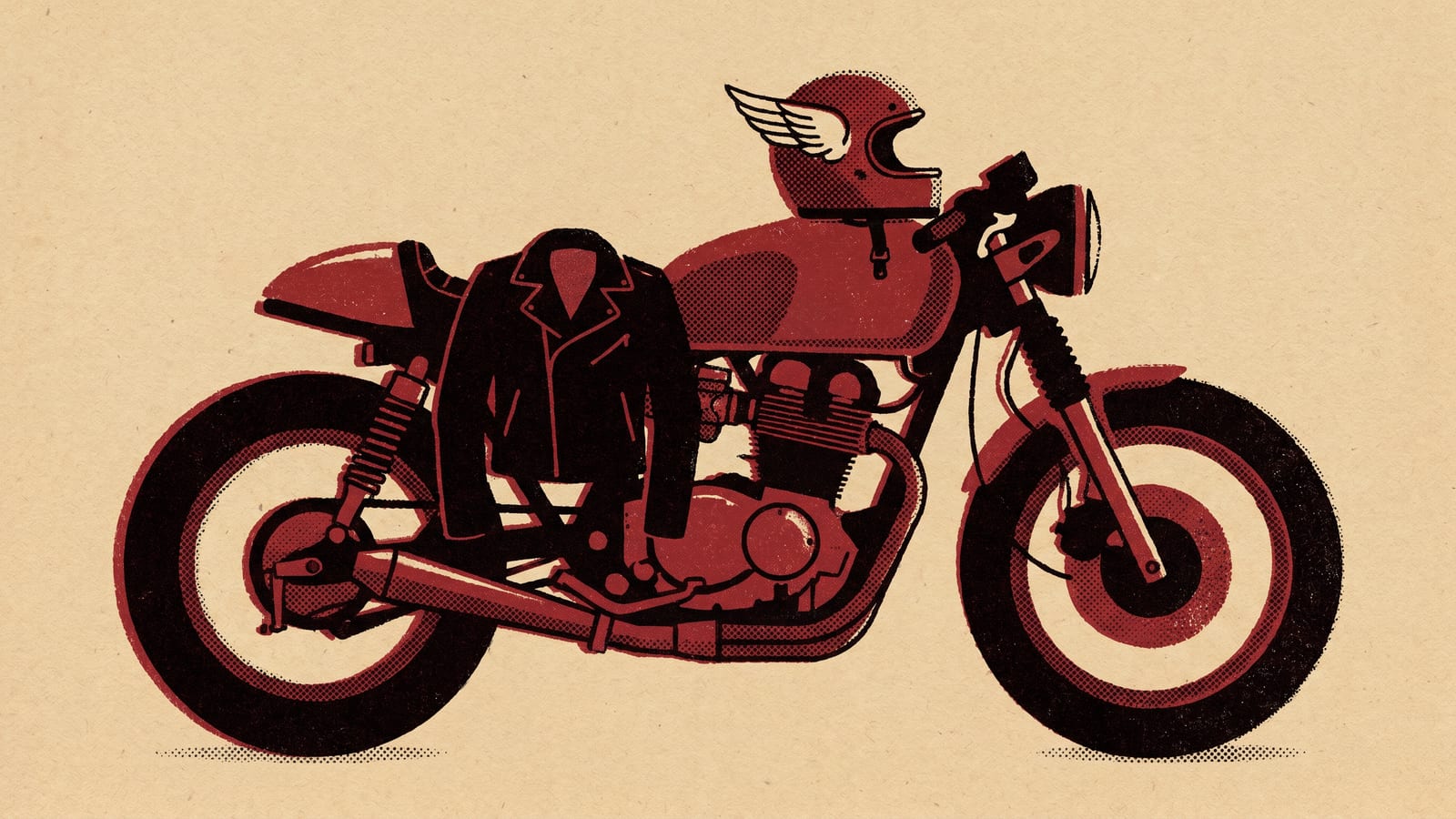
Before there were mods, there were rockers. Not in opposition to mods at first, simply as a fact of post-war British street life: young, working-class, obsessed with motorcycles and American rock and roll, and not remotely interested in what anyone thought about it.
Where they came from
The rocker subculture took shape in the mid-to-late 1950s, fed by several things arriving at roughly the same time. Post-war rationing ended. Working-class youth had some disposable income, often for the first time in their families’ histories. British motorcycle engineering was at its peak, producing fast, relatively affordable machines. And American rock and roll was coming over on record and, occasionally, in person.
The look owed something to Marlon Brando in The Wild One (1953), the leather jacket and denim combination that signalled something threatening and glamorous in equal measure. But it was not imported wholesale. The rockers built their own version around the specific rituals of British café culture and the particular thrill of the North Circular Road at night.
The teddy boys had already staked out rock and roll as working-class territory a few years earlier, and there is overlap between the two groups, especially in the early years. The rocker was the teddy boy who bought a motorbike.
The Ace Cafe
The Ace Cafe on the North Circular Road in north-west London opened in 1938 as a straightforward transport cafe, rebuilt in 1949 after wartime bomb damage to the adjacent railway marshalling yards. By the mid-1950s it was the centre of gravity for the emerging scene. Open around the clock, positioned on one of the fastest urban roads in Britain, it drew in riders who came to drink tea, play the jukebox, and race.
The ritual was simple. You put a record on the jukebox, got on your bike, rode a circuit of the North Circular before the song ended, and came back. The record playing became a countdown. This is where the term “café racer” came from: the specific stripped-down motorcycle built to win that kind of sprint. The Ace closed in 1969, reopened in 1997, and still runs today as a museum piece of itself, which is either touching or ironic depending on your temperament.
Doing the ton
The defining aspiration of the subculture was “doing the ton”: hitting 100mph. The ton-up boys, as the press called them, were the ones who had made it. The ton was not just speed for its own sake. It was proof of nerve, mechanical ability, and the quality of your machine. A BSA, Triumph, or Norton capable of the ton was something you earned and maintained yourself.
The bikes were modified accordingly. Fairings lowered to reduce drag, handlebars replaced with clip-ons, rear sets fitted to put the rider in a crouch. The whole aesthetic of the café racer, which has never really gone away, comes from this functional logic.
The music
The rockers were named after their music as much as anything else. American rock and roll, specifically the harder-edged end of it, was the sound. Gene Vincent and Eddie Cochran were central figures, and their 1960 UK tour, promoted by Larry Parnes, was a major cultural moment. Cochran died in a car crash in Wiltshire at the tour’s end in April 1960. Vincent, who was injured in the same accident, carried on performing and remained a particular hero of the British scene, partly because he never quite went back to America and his star kept burning in Britain long after it had dimmed at home.
The leather jacket, the pompadour, the aggressive physicality of Vincent’s stage persona: all of it fed directly into what the rockers were building visually. The music and the look were one thing.
The clashes with mods
By the early 1960s, the mods had emerged as the rockers’ obvious opposite: scooters versus motorbikes, Italian tailoring versus leather, soul and R&B versus rock and roll. The tension was real, but it was the media that turned it into a national story.
Whitsun weekend, May 1964. Brighton, Margate, Hastings. Hundreds of teenagers, some fights on the beach, some broken deckchairs. The press ran it as a seaside riot and the country panicked accordingly. Stanley Cohen later used the events as the centrepiece of his 1972 study on moral panics. The actual violence was serious but limited; the coverage was not. One of the most-reproduced photographs from Brighton was later identified as staged, with a journalist reportedly paying participants to re-enact a confrontation for the camera.
What they wore
The rocker uniform was less variable than the mod look. Black leather jacket, the heavier and more beaten-up the better. Denim jeans. Black leather boots, often engineer or western style. The jacket frequently carried patches and hand-painted slogans. Hair in a quiff or pompadour, held with Brylcreem.
The look was practical as much as symbolic. Leather protects in a crash. The boots grip footpegs. But the choices within that practical framework, the specific jacket, the way the hair sat, the patches chosen, were read carefully within the scene. It was a uniform that allowed for significant personal variation if you knew what to look for.
Legacy
The rocker subculture never really disappeared. It mutated into the biker subculture of the 1970s, influenced the early heavy metal aesthetic, and the café racer as a motorcycle type has had continuous revivals ever since. The Ace Cafe reunion events, which started drawing thousands of riders after the 1997 reopening, suggest there is still genuine emotional weight in the original scene, even for people born decades after it peaked.
The look, the bikes, the music: all of it is still recognisable. That is either a testament to how coherent the original subculture was, or to how effectively the nostalgia industry has preserved it. Probably both.