Skinhead Fashion & Style – A Complete Guide
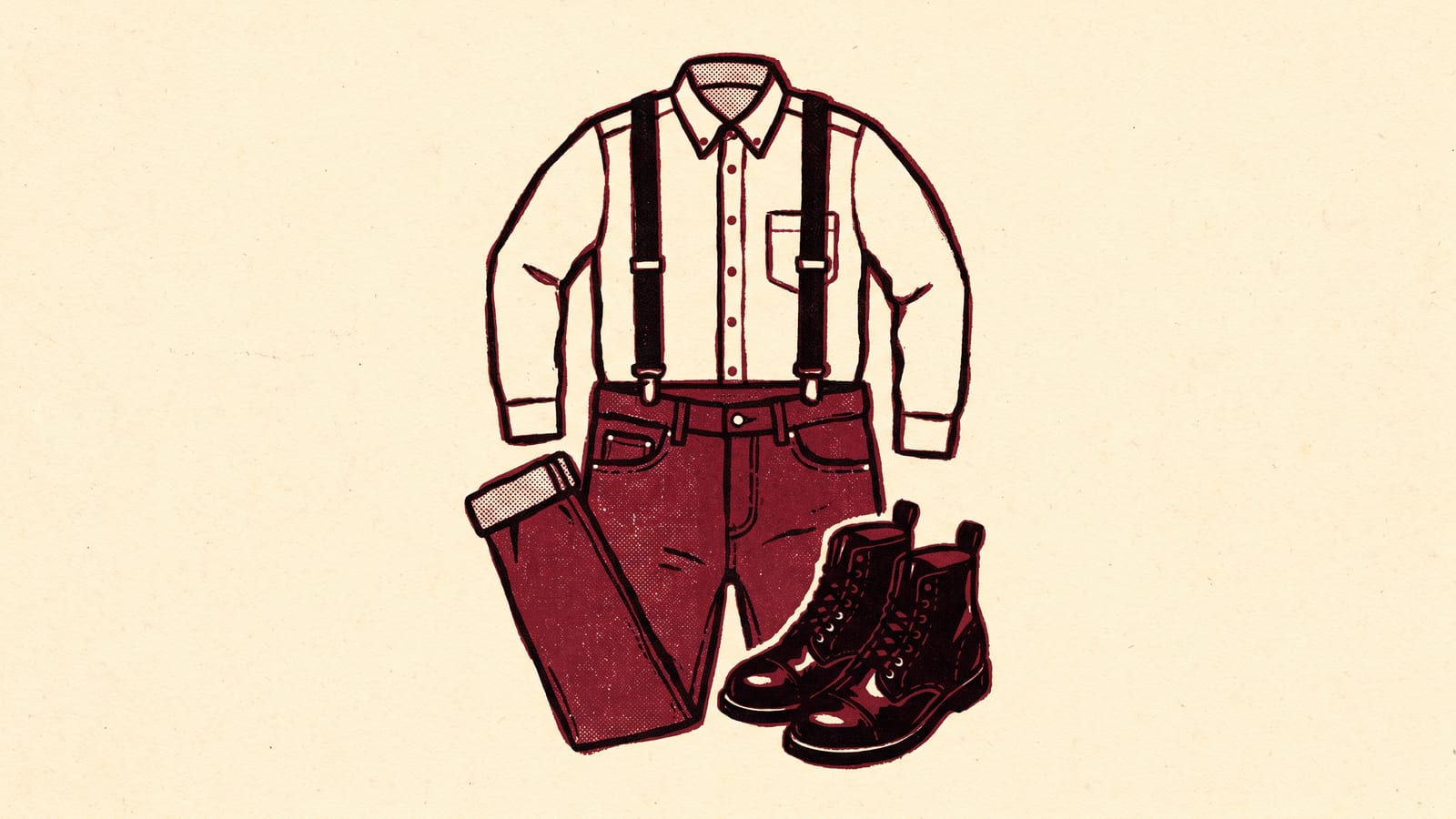
Skinhead style is not an accident of aesthetics. It is a working uniform dressed up just smart enough for Saturday night, and the logic behind it has stayed consistent from the late 1960s to now. Start with that premise and the whole wardrobe makes sense.
The scene grew from working-class British youth in the late sixties, partly out of the harder end of the mod scene and partly from the cross-cultural exchange happening in the shared dance halls where young white Britons were absorbing rude boy style from Jamaican immigrants. The rude boy brought sharp tailoring, pork pie hats, and an attitude about dress that was simultaneously tough and fastidious. The skinhead took that and stripped it down. Less flash, more function. The suit stayed, the hat stayed for some, but the overall silhouette got tougher, shorter, closer to the ground.
That working-class grounding is not just sociological context, it shapes the clothes directly. Everything in the skinhead wardrobe is either genuinely functional workwear adapted for street use, or a deliberate smartening-up of workwear signifiers. The boots are steel-toed industrial footwear. The braces hold your trousers up on a building site. The Levi’s were American labour denim. The donkey jacket was what dockers and miners actually wore. None of this is ironic or nostalgic in the way that later subcultures would romanticise working-class gear. For the original skinheads, it was their class’s actual clothing, claimed rather than borrowed.
The “smart-but-hard” balance is the defining tension. A skinhead in 1969 in a well-pressed tonic suit, a Ben Sherman, polished boots, and cropped hair was making a deliberate statement: clean, disciplined, presentable, but unmistakably dangerous. Not a hippie, not a student, not aspiring to middle-class invisibility. The clothes communicated all of that without needing a word. You could spot it from across the street.
The style has been remarkably stable. The revivals of the late 1970s (when the Oi scene brought a rougher, more punk-adjacent version), the two-tone moment that re-introduced rude boy sharpness, and the subsequent traditional skinhead scene all drew from the same basic wardrobe. Individual items come in and out of favour, particular brands get dropped or championed, but the underlying logic remains: workwear roots, smart presentation, hard-wearing quality, nothing surplus to requirements.
What follows is a detailed guide to the specific items, with extracts from George Marshall’s Spirit of ‘69: A Skinhead Bible (1994) throughout, since it remains the most authoritative insider account of what skins actually wore and why. Marshall was a Glaswegian skinhead writing from inside the scene, and his A-Z of skinwear is part style guide, part affectionate cultural record. Read the quotes as texture, not scripture.
Hair
Before the clothes, the hair. Skinhead hair is either short-cropped or shaved close to the skull, and it is as much a part of the look as any garment. The crop communicates the same things the clothes do: no messing, no frills, practical. Skinhead girls typically wore the chelsea cut, sometimes called a feathercut, with a fringe at the front and cropped hair at the back.
Footwear
Boots
If one item defines the look from the outside, it is the boots. More specifically, it is Doc Martens, though the route to DMs as the dominant skinhead boot took a few years.
The earliest skins wore whatever hard boots they could get: army surplus, steel-toe-capped NCB boots (National Coal Board issue), monkey boots, anything with weight and durability. Steel-toed boots were favoured partly for obvious practical reasons on the street, until they were reclassified as offensive weapons, at which point Doc Martens became the practical replacement. The air-cushioned sole was comfortable enough for long days, the boots were available in the right range of colours, and they had exactly the right combination of workwear authenticity and polish potential.
Cherry red and black are the classic colours. Oxblood and burgundy variants followed. The standard heights are 8-hole and 10-hole, though 12 and 14-hole versions exist. Skins who take their polish seriously go to some lengths with DMs, the boots should have a mirror shine, and they are treated accordingly. Scuffing a fresh pair on purpose, known as “blooding” or “christening,” was a social ritual among mates, which says something about the culture’s relationship with both pride and ridicule.
In 2003 Doc Martens moved production to Asia (the Northamptonshire factory closed), and many long-term skinheads feel the quality dropped noticeably after that. The UK alternative that has filled the gap is Solovair, made in the same Northamptonshire factories by the same craftspeople who originally made DMs, and visually nearly identical.
A-Z: Boots - Originally studded army boots with steel toe caps, NCB boots, monkey boots or anything else you could get your hands on, but eventually DMs became top dog, not least because steelies were classed as an offensive weapon. Cherry red and black were most popular, although black boots lost their appeal for some when black DMs became standard issue for plods.
Steelies - Steel toe-capped boots were very popular because of their aggro potential. One kick in the balls and few would come back for more. But once they were classed as an offensive weapon, other types moved in on the boot territory.
Doc Martens - Also called docs and DMs, the most famous make of shoe and boot thanks to its “air wair” soles invented by the good Austrian doctor. Very comfortable, hence their popularity. They are available in 8, 10, 12, 14 and even 20 holes (count the eyelets up just one side of the boot) and most sizes, including small kids. 8–12 holes are most popular. Black and cherry red as standard and steel toe caps are available too.
Polish - Proper spit and polish merchants are skinheads. Certainly if you take pride in how you look you can’t go out without a shine on your boots or shoes, even if they are then trampled into the ground at gigs.
Lace code
The boot lace colour code is one of those things that generates more heat than light. In theory, different lace colours signal political allegiances. In practice, the meanings vary by region, era, and whoever happens to be most opinionated in a given crowd. Most skinheads choose laces based on what looks best against their boots. White, black, and red are the most common choices. See the Doc Martens lace colour guide for the longer version.
A-Z: Laces - The colour of boot laces causes more arguments than a blind referee. The problem is that different colours mean different things in different areas. White might be NF in one town and anarchy in the next. In Montreal, yellow’s meant to mean cop killer. What makes it worse is that there is always some know-all who claims to know the lot. Not exactly Earth-shattering stuff.
Other shoes
Boots are not the whole story. Brogues, oxfords, and loafers are all legitimate and have been worn since the original scene. Penny loafers in particular carried straight over from the mod era. Adidas Samba trainers became a popular option from the 2000s onwards and are now well-established as an alternative to boots, particularly for the Watford Tuxedo combination described under Trousers below.
Brogues - Lace up shoe with holes punched over the toe and down the sides to form a pattern. Black, brown or burgundy in colour. Steel toe caps were an optional extra. In the States they are commonly known as Cordovans.
Loafers - Plain slip-on shoe usually with a fringed strip across the tongue. Usually one of the toggles falls off though. Black most popular thanks to 2 Tone.
Braces
Along with the boots, braces (in American English: suspenders) are the most visually distinctive element of the skinhead look. They are worn for style as much as function.
The key rule is width: skinhead braces run narrow, typically around a quarter-inch. Wider braces look wrong. The other rule is simpler: never wear braces and a belt simultaneously.
A-Z: Braces - Meant to hold your trousers up, but usually worn for style. Certainly not worn for comfort because they do your balls in most of the time. Sometimes worn over a thin pullover or tank top. Wider originally than the quarter inch common today, with half inch, 1” and even 2” being sported. They were also worn over the shoulder and not around your bum until punk came along.
Shirts
The canonical skinhead shirt is an American-style button-down collar shirt, and the dominant brand has been Ben Sherman since the sixties. The button-down collar (including the back collar button), the back pleat, the hanging loop, and the left breast pocket are the identifying features. Sherman, who launched the brand in Britain in the early sixties, had the shirts taken up first by mods and then emphatically by skinheads. “Bennies” are available in plain, checked, and striped, the check varieties are particularly associated with the look.
Fred Perry is the polo shirt of choice. The brand takes its name from the British tennis player who dominated the sport in the 1930s, and the laurel wreath logo became a fixture with mods in the sixties before crossing directly into skinhead use. The original Fred Perry polo had four buttons; it went to three and then two over the decades. All buttons done up, as Marshall notes, which is the opposite of the Ben Sherman convention (top button undone, sleeves rolled once or twice).
Brutus is the third pillar of skinhead shirts, particularly for check and tartan button-downs. The Brutus Gold button-down check was a standard item.
A-Z: Shirts - American style button down shirts easily the most popular. Always worn with top button undone and long sleeves rolled up once or twice. Freds usually worn with all buttons done up.
T-shirts are common, especially band shirts. For the Oi end of the scene, a band or football club T-shirt under braces is entirely standard.
For knitwear, cardigans and tank tops cover it. Fred Perry makes cardigans, which gives them instant legitimacy. Tank tops with braces was a look associated with the early seventies.
A-Z: Cardigan - Fred Perry makes them so they must be okay. Chunky ones with pockets look best, but remember to leave the bottom button undone.
Tank Top - Sleeveless jumper popular in the early Seventies. Usually patterned, sometimes in really bad taste. Braces were sometimes worn over them.
Jackets
Harrington
The Harrington is the go-to skinhead jacket today. Lightweight, zip-front, with a tartan lining and a button-up collar, it has been part of the scene since the original period. The name supposedly comes from Rodney Harrington, a character in the American TV serial Peyton Place, who was frequently seen wearing one. It was available for a period in tonic and Prince of Wales check patterns as well as the standard colours (black, red, and fawn are most popular). Suedeheads adopted it too, though by the mid-seventies it had gone mainstream high street.
A-Z: Harrington - Lightweight jacket, named after Rodney Harrington, a character on TV’s Peyton Place. Zip up front, button up collar. It has always been available in various colours, with a tartan lining as standard, but as with most things the quality of them today isn’t a patch on the ones being sold in ‘69.
Crombie
The Crombie (short for Abercrombie) is a smart overcoat that was picked up by the skinhead scene as early as 1968, well before it became associated with the slightly later suedehead evolution. It had already spent decades as the coat of choice for shady dealers and gangsters before the skins got hold of it. A real Abercrombie is expensive; most made do with cheaper versions. Velvet collar, a left breast pocket for a handkerchief, and enough weight to hold its shape are the marks of a decent one.
A-Z: Crombie - Despite what you may have read elsewhere, crombies were not post-1970 suedehead wear. They have been the mainstay of shady deals and gangsters for decades, and were picked up by the skinhead cult as early as ‘68.
Bomber Jacket
The olive green MA-1-style flying jacket became extremely popular with the skinhead revival crowd in the late seventies and eighties. The black bomber is more complicated: it became associated with white power skins, which put it off-limits for much of the scene. Olive green or air force blue are the safer choices.
A-Z: Bomber Jacket - It must be the most popular jacket on sale today. Olive green tops the colour charts, although black ones are most popular with white power skins ironically enough.
Donkey Jacket
The donkey jacket is the most explicitly workwear item in the jacket range: it is what dockers, miners, and labourers actually wore. An orange or black waterproof panel across the upper back is the mark of a decent one. Names were sometimes stencilled on plain versions. Cheap, deep-pocketed, warm, and carrying the exact working-class authenticity the scene was built on.
A-Z: Donkey jacket - Good enough for dockers, miners and labourers, and certainly good enough for their sons and daughters too.
Sheepskin
An expensive item that was nevertheless popular, particularly with the football crowd. Covers the bum is the preferred length. Fawn and dark brown are the usual colours.
Trousers
Levi’s 501 red-tag jeans are the default. The 501 is a button-fly jean, though some preferred the zip-fly 505. Orange tab Levi’s are viewed with suspicion in some circles, though Marshall is suitably bemused by that particular piece of snobbery.
For the smarter end of the look, Sta-Prest trousers are the standard: they are permanently pressed, crease-holding, and genuinely smart. Levi’s Sta-Prest in white are considered the benchmark. Colours include white, burgundy, black, ice blue, and fawn.
The Oi-era look introduced bleached jeans, which push the silhouette slightly toward punk. Army combats were worn by original skins and have since become more associated with the bonehead end of the scene, which Marshall notes with appropriate regret.
A-Z: Sta-Prest - Trousers that never needed ironed, and very smart too. Made by a number of companies, but none could touch Levi’s whose white ones were stunning.
The Watford Tuxedo deserves its own note. It is the combination of polo shirt (Fred Perry, Ben Sherman, or Oi band), camo shorts, white socks, and Adidas Sambas, and The Old Firm Casuals immortalised it in their song of the same name. It is the hot-weather street uniform and the least formal point of the skinhead style spectrum.
Step one: polo shirt of your favourite Oi band, Fred Perry or Ben Sherman. Step two: camo shorts. Step three: white socks and Samba shoes, short cropped hair.
Suits
The suit is where the rude boy influence is most visible. Tight, three or four button, narrow lapel, side or back vents. Mohair (Angora wool, expensive) or the cheaper Trevira equivalent. Tonic cloth, which shifts colour in the light, is the other key fabric and connects directly to the two-tone revival.
A-Z: Suits - Three and four buttons, narrow lapel, and either a middle or back vent or two side vents (up to 18” long) are standard features. Ticket pockets are another nice touch. Competition for the best suit often saw extra ticket pockets being added.
Buttons on the sleeve, three as a minimum. The bottom jacket button stays undone. Trousers short enough to show the top of your shoe and a stripe of sock. Summer colours: petrol blue, green, navy. Winter: black and brown.
Hats
The pork pie hat (also called a blue beat hat or stingy brim) came straight from the rude boy look, and it is one of the clearest through-lines in the style’s heritage. Black is the most common colour.
A-Z: Pork Pie Hat - Narrow brimmed trilby hat borrowed from the rude boy look. A decent one will last years longer than the cheap kiss-me-quick variety.
The bowler hat is the suedehead option, immortalised in A Clockwork Orange. Flat caps and skull caps (woollen beanies, colloquially “Benny hats”) round out the range for colder weather.
Skinhead Girl Fashion
Skingirls share most of the same wardrobe: button-downs, polo shirts, boots, braces, 501s. The main differences are mini-skirts (denim cut from old 501s, dogstooth, tonic, or plain) and fishnet or patterned stockings, with white ankle socks worn over them. The chelsea cut is the hair counterpart to the male crop.
A-Z: Mini-skirts - Now we’re talking! Denim (often made from an old pair of 501s), dogstooth, Prince Of Wales, plain, tonic, you name it. Very smart with matching jacket, shirt and stockings.
Accessories
Scarves are either football club colours or paisley. Gillingham FC scarves are specifically noted by Marshall with a straight face.
Socks should be plain white sports socks. Red is the distant second choice.
Cravats in paisley, tucked into the collar, are a smart-end addition. Ties only appear at weddings and funerals.
Tattoos are common and cover the usual subjects: football clubs, bands, partners, firms. A star in the left palm was a London-specific marker at one point. ACAB.
Umbrellas with sharpened tips are a suedehead accessory, not skinhead proper.
Key Brands
| Brand | What it covers |
|---|---|
| Ben Sherman | Button-down shirts; the default skinhead shirt since the sixties |
| Fred Perry | Polo shirts, cardigans, some outerwear; the laurel wreath is standard issue |
| Dr. Martens | Boots; cherry red and black in 8-hole and 10-hole as the standard |
| Solovair | UK-made alternative to DMs since the 2003 production move |
| Levi’s | 501 red-tag jeans and jackets; also Sta-Prest trousers |
| Brutus | Button-down and tartan shirts, particularly Brutus Gold check |
| Lonsdale | Vests and sweatshirts; became popular via the Carnaby Street shop |
| Lee / Wrangler | Jeans alternatives to Levi’s, especially in the north |
“Skinhead was never meant to be about label twitching, and this guide is not an attempt to lay down the law about what you can wear and what you can’t. It’s simply a guide to what is widely worn today and has been worn in the past. There can be no room for snobbery in a cult that prides itself in being working class.”
George Marshall (Spirit of ‘69: A Skinhead Bible, 1994)
That quote from Marshall sums up the governing principle. The clothes matter because taking care of your appearance is a form of self-respect, not because owning the right labels makes you more legitimate than someone who can afford only one Fred Perry and a pair of boots. The style is a working-class inheritance and it belongs to whoever wears it properly.
For the cultural and historical background behind the look, see skinheads, the rude boy origins, and the Oi music guide.